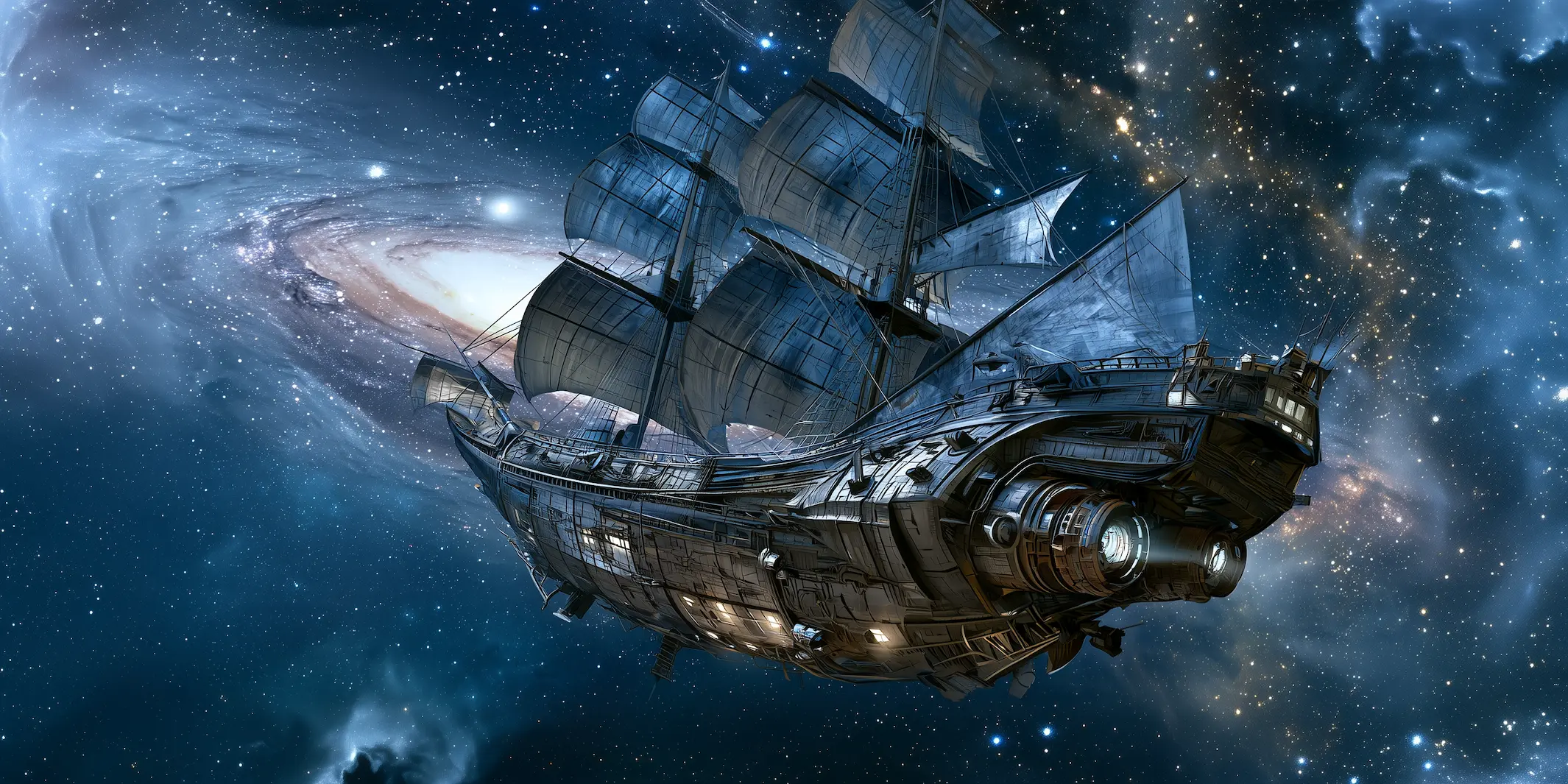
There is a difficulty in discussing the Universe.
The difficulty is not that we know too little. It is that we know enough to become dangerous.
We know that galaxies rotate. We know that light bends around invisible mass. We know that distant galaxies appear to be moving away from us. We know that this recession, on the largest scales, is accelerating.
We have names for the causes. Dark matter and dark energy.
The names are useful because science requires labels, but labels should not be mistaken for explanations.
A person who asks what holds a ship above the seabed has learned very little if told, “the ocean.”
He must still ask what the ocean is.
Perhaps we should ask the same question of space.
Suppose that space is not emptiness.
Suppose it is a physical medium.
Not an ether in the old nineteenth-century sense, which was invented to carry light and then largely discarded when relativity made it unnecessary. Suppose instead that the medium is something deeper: a continuous cosmic substance whose properties generate the phenomena we presently divide into dark matter, dark energy and perhaps even gravity itself.
Call it the cosmic ocean.
This does not make it a scientific theory merely by naming it. A theory must possess mathematics, predictions and ways to fail.
Still, every theory begins as an idea before it becomes an equation.
So let us build the idea carefully.
1. Space as a Medium
The first assumption is simple.
The Universe is filled everywhere with an underlying medium.
It does not interact strongly with ordinary electromagnetic radiation, so we cannot see it directly. Light passes through it almost as though it were absent.
But it has density, pressure and motion.
And perhaps most importantly, its density and motion affect ordinary matter.
If that sounds strange, consider water.
A fish cannot see water in the way it sees another fish, yet its entire world is determined by the water.
The pressure changes with depth.
Currents move it and vortices spin it. Waves carry energy through the medium.
The fish may be tempted to describe all these effects separately until it eventually discovers that they are behaviors of the same substance.
Perhaps cosmology is in that position now.
Dark matter may be one behavior of the cosmic ocean.
Dark energy may be another.
Gravity may even be related to the way ordinary matter disturbs it.
2. Dark Matter as Cosmic Density
Astronomers infer dark matter because visible matter does not seem to provide enough gravity.
Stars near the outer regions of galaxies often orbit faster than expected from the distribution of visible mass. Galaxy clusters bend light more strongly than their luminous matter alone should permit. The large-scale structure of the Universe also appears to have required additional gravitational influence during its development.
The standard interpretation is that dark matter consists of some form of unseen matter, probably particles not yet directly detected.
The cosmic ocean model would propose something different.
What if a galaxy creates, attracts or resides within a local increase in the density of the cosmic medium?
A galaxy would then sit inside what might be called a density basin.
The visible stars would occupy the center, but the invisible medium surrounding them would contribute additional gravitational effects.
This would resemble a dark matter halo, but the halo would not necessarily consist of countless invisible particles orbiting independently.
It might be a continuous region of altered cosmic density.
A galaxy, in this picture, becomes rather like a whirlpool.
The visible stars are the foam.
The invisible structure beneath them is the water.
The great attraction of this idea is not that it sounds better.
Physics is indifferent to beauty.
Its attraction would be that a continuous medium might naturally form large structures without requiring every gravitational effect to be traced to individual particles.
Whether nature actually behaves that way is another matter.
3. Dark Energy as Current
Dark energy is stranger.
At the largest scales, the Universe appears not merely to expand, but to expand at an accelerating rate.
Standard cosmology often represents this effect with a cosmological constant: an energy density associated with space itself.
The cosmic ocean model asks whether what we call expansion might instead be partly the motion of the medium.
Imagine two corks floating in a broad current.
The corks move apart. If each cork contains a scientist who can observe only the other cork, each scientist will conclude that the distance between them is increasing.
That observation is correct.
But the interpretation may not be.
The water between the corks need not be newly created.
The corks may simply be carried by a divergent flow.
Suppose the cosmic ocean contains currents on scales vastly greater than galaxies.
Then galactic separation may reflect that flow.
Dark energy would not be a mysterious repulsive substance added to the Universe.
It would be the large-scale motion of the medium itself.
The greater the scale, the more noticeable the current.
To us, the result could look very much like accelerated cosmic expansion.
4. No Beginning Is Required
Now we arrive at the part that most violently disagrees with the usual story.
Suppose the cosmic ocean has always existed.
No creation event or first instant. No absolute discernible beginning.
The Big Bang, in this model, would not represent the origin of all existence.
It would represent an event within the ocean, a change of state.
Imagine an enormous region of the cosmic medium flowing inward.
As the medium compresses, energy density rises.
Matter becomes concentrated.
Temperature increases enormously.
Eventually the state becomes unstable and the flow reverses.
An immense outward movement begins.
Matter cools, particles form and atoms form. The stars and galaxies appear.
Observers evolving billions of years afterward extrapolate backward and conclude that everything began in a hot, dense state.
They would be right about the hot, dense state.
They might be wrong about it being the beginning.
A wave can have a beginning without the ocean having one.