11. What Would the Cosmic Ocean Predict?
A useful speculative theory should risk being wrong.
The cosmic ocean model might produce several testable predictions.
First, dark matter distributions should behave like continuous fluid structures rather than simply collections of collisionless particles.
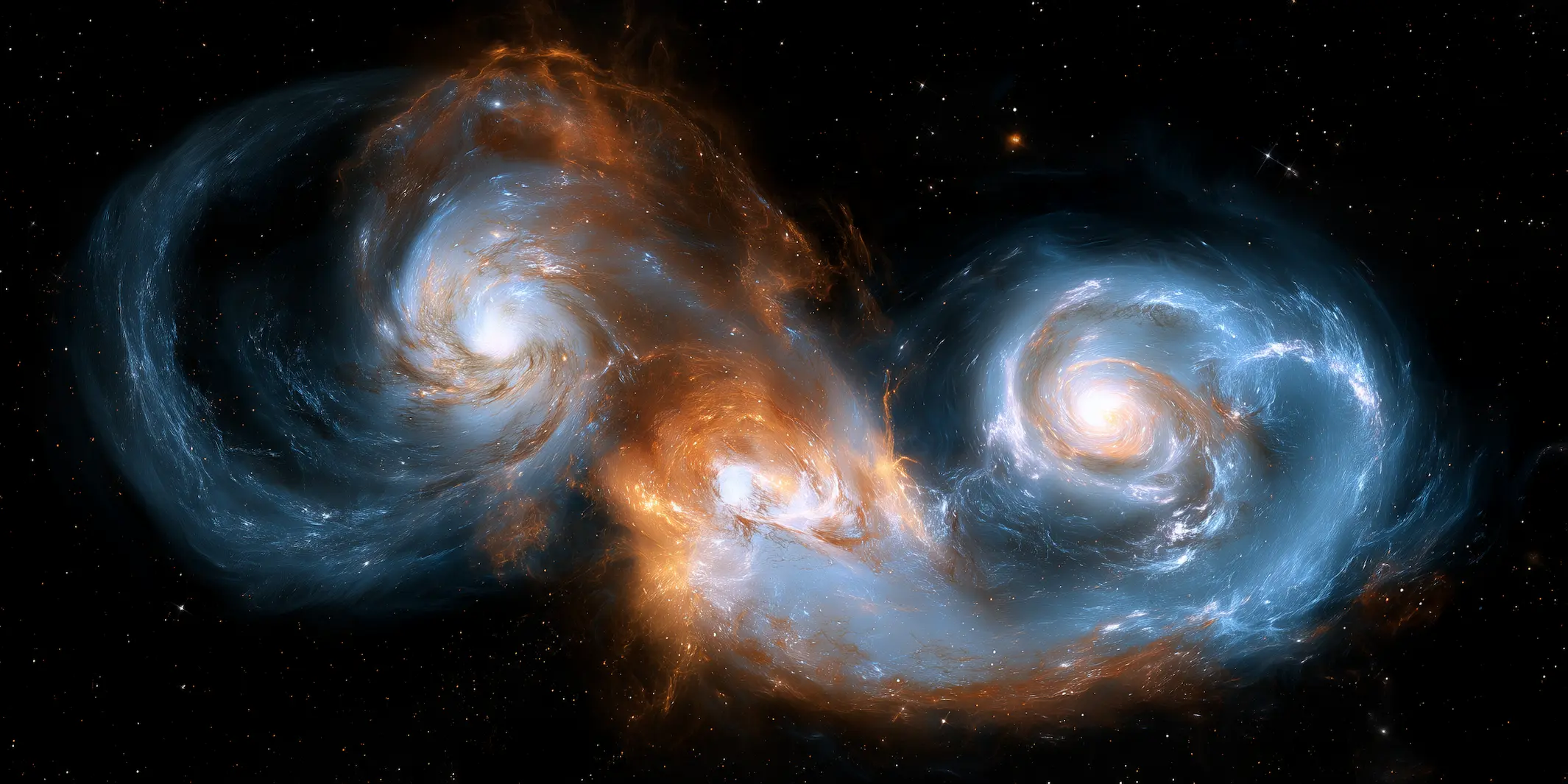
Galaxy collisions could reveal distinctive drag, shock or wave behavior in the invisible component.
Second, gravitational effects around rotating galaxies might show subtle asymmetries associated with circulation in the medium.
Third, cosmic expansion might vary slightly with direction if we occupy a region influenced by enormous currents.
Such deviations would have to be extremely small because observations show the Universe to be highly uniform on large scales.
Fourth, gravitational waves might interact with the underlying medium in a measurable way.
Their speed is already known to be extraordinarily close to the speed of light, so any fluid model would have to preserve that fact.
But perhaps dispersion, polarization or tiny frequency-dependent effects might someday reveal structure in the vacuum.
Fifth, the distribution of galaxies in the cosmic web might show mathematically fluid-like properties beyond those expected from standard gravitational evolution.
Sixth, black hole mergers might reveal unexpected energy transfer into the medium, possibly appearing as deviations from the predictions of general relativity.
Every one of these possibilities would have to survive precision measurements.
Most speculative theories die there.
That is not a tragedy.
It is the purpose of measurement.
12.The Cosmic Microwave Background Problem
There is one great obstacle that no alternative cosmology can ignore.
The cosmic microwave background.
It is the faint radiation filling the Universe, interpreted as leftover light from the time when the early Universe cooled enough for atoms to form and photons to travel freely.
Its temperature is extraordinarily uniform, with tiny variations that match predictions of modern cosmology remarkably well.
Any cosmic ocean model must explain it.
One possibility would be that the background radiation originated not from the birth of the Universe, but from the most recent great compression and release cycle.
The cosmic medium would have reached an extremely hot equilibrium state.
As the tide moved outward and matter cooled, radiation would decouple from matter.
The result could mimic the relic radiation of the Big Bang.
But “could” is doing heavy work in that sentence.
The spectrum of the cosmic microwave background is measured with extraordinary precision.
A viable alternative would need to reproduce it almost perfectly.
Nature does not reward theories for sounding reasonable.
It rewards them for being right to many decimal places.
13. The Question of Time
If the ocean has always existed, then time becomes interesting.
Did time itself exist forever? Or does time emerge from changes within the medium? We normally think of time as something through which the Universe moves.
But perhaps time is merely our measure of the ocean changing.
If nothing changed, could time be said to pass? There is no easy answer.
A cyclic cosmic ocean might contain no absolute beginning, but individual structures within it would still have histories.
Stars would be born and die.
Civilizations would rise and vanish.
Entire observable universes might come and go.
Infinity would not mean that everything lasts forever.
It would mean that the process does.
A wave is temporary but the sea remains.
14. Why Nature Likes Cycles
There is an appealing consistency to the idea.
Nature recycles.
Water rises and falls as rain.
Carbon moves through organisms, atmosphere and rock.
Stars manufacture elements and scatter them into space.
Galaxies merge and form new stars.
Nothing stays fixed.
Patterns appear, change and return in altered forms.
Perhaps our insistence on a single cosmic beginning is partly psychological.
We are born, therefore we assume the Universe must have been born.
We die, therefore we imagine it must eventually die.
But nature is under no obligation to resemble a human biography.
The Universe might not have a birth certificate.
It might have tides.
15. The Danger of the Ocean
There is one final caution.
The cosmic ocean is an analogy.
Analogies are useful precisely because they simplify.
They are dangerous for the same reason.
Space is not ordinary water.
Galaxies are not literally floating ships.
Dark energy is not presently known to be a current.
Black holes are not known to be drains.
And there is overwhelming observational support for the hot early Universe described by modern Big Bang cosmology.
Any serious cosmic ocean theory would have to explain every successful prediction of current cosmology and then explain something current cosmology cannot.
Only then would it deserve to replace anything.
Until that happens, it remains a thought experiment.
But thought experiments have a respectable history.
They encourage us to look at familiar facts from unfamiliar directions.
And sometimes the most important question in science is not, “What do we know?” It is, “What have we assumed?” We have assumed that the dark regions between galaxies are principally empty.
We have assumed that cosmic expansion represents the behavior of spacetime itself.
We have assumed that the hot early Universe marks, in some sense, the beginning of cosmic history.
Perhaps all three assumptions are correct.
But imagine that they are not.
Imagine that empty space is the deepest substance in existence.
Imagine that dark matter is its density.
Dark energy is its motion.
Galaxies are its vortices.
Black holes are its deepest currents.
And the observable Universe is merely one immense tide passing through something immeasurably older.
Then the beginning was not a beginning.
The end will not be an end.
The Universe does not explode once and fade forever.
It breathes, circulates, rises and falls.
The tide goes out and the tide comes in.
And somewhere on a small planet beside an ordinary star, intelligent creatures look upward at the dark spaces between the galaxies and wonder why most of the Universe cannot be seen.
Perhaps the answer is simpler than they imagine.
A fish cannot see the ocean either.