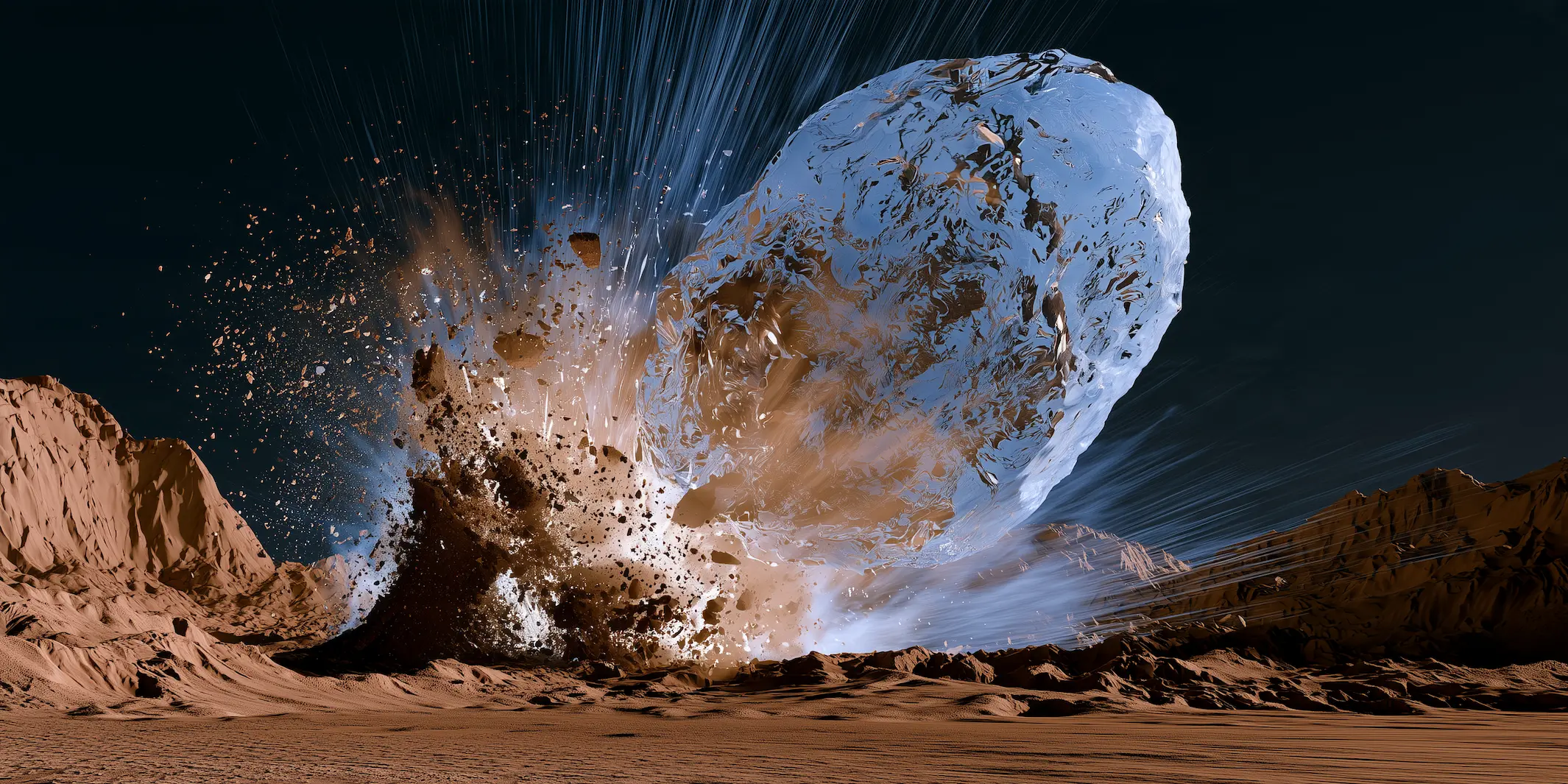
A possible tract to bring water to Mars.
There is a wonderfully simple and elegant solution to the problem of terraforming Mars.
Mars is too cold, too dry, and its atmosphere is much too thin for human beings to walk about comfortably. Therefore, one might say: give it more water, give it more gas, and warm it up some.
The difficulty begins when someone asks where all that water and gas are supposed to come from.
One possible answer is floating between Mars and Jupiter.
The main asteroid belt contains millions of rocky bodies, and some of them contain substantial quantities of water. The water may exist as ice, particularly in colder outer regions of the belt, or chemically bound inside hydrated minerals. If suitably water-rich asteroids could be redirected toward Mars, their impacts might release water vapor, carbon dioxide and enormous quantities of heat.
Could we deliberately tow such asteroids to Mars and use them to help manufacture an atmosphere?
In principle, yes. In practice, the word “tow” conceals nearly the entire problem.
An asteroid does not need a rope. It needs its orbit changed. A spacecraft attached to it could apply a small but continuous thrust over years or decades, slowly altering its velocity until the asteroid entered a trajectory intersecting Mars.
Several methods have been suggested for moving asteroids. Electric propulsion could use solar or nuclear energy to drive ion engines for long periods. A spacecraft might attach directly to the surface, although the loose rubble composing many asteroids would make that difficult. Another method, called a gravity tractor, would place a spacecraft near the asteroid and allow the tiny gravitational attraction between the two bodies to gradually alter the asteroid's path.
For very large objects, one could imagine installing engines directly on the asteroid, ejecting some of its own material as reaction mass.
None of these methods violates known physics. That is not the same thing as saying they are easy.
Even a modest asteroid may have a mass of billions of kilograms. Moving such an object significantly requires either tremendous energy or tremendous patience.
Fortunately, orbital mechanics rewards patience.
An asteroid does not necessarily need to be accelerated toward Mars like a cannonball. Its orbit merely needs to be modified by the correct small amount at the correct time. A change in velocity of a few meters per second, applied years before the desired encounter, might eventually shift the asteroid by millions of kilometers.
The celestial mechanics can therefore be manageable. The consequences of arrival are another matter.
Suppose a water-rich asteroid several kilometers across were directed into Mars. It would strike the planet at several kilometers per second. The kinetic energy released would be comparable to that of many nuclear weapons.
The collision would excavate an enormous crater and vaporize much of the incoming asteroid along with considerable quantities of Martian rock.
If the asteroid contained ice, a portion of that ice would become water vapor, that sounds useful.
Water vapor is a greenhouse gas. It could temporarily warm the atmosphere, and some of it could later fall as snow or rain if Mars became sufficiently warm.
Impact heating could also release carbon dioxide trapped in Martian polar deposits and soil. Carbon dioxide is another greenhouse gas. A carefully planned sequence of impacts might therefore create a reinforcing effect: impact heating releases gases, gases warm Mars, and warming releases still more gases.
This is the attractive version of the idea. Mars, unfortunately, is not obliged to cooperate.
One problem is gravity.
Mars has only about 38 percent of Earth's surface gravity. Its escape velocity is much lower than Earth's, and extremely energetic impacts can eject atmospheric gases and surface material into space.
A sufficiently violent collision could therefore add water with one hand while removing atmosphere with the other. The size and velocity of the incoming bodies would have to be chosen carefully.
There is another difficulty.
Mars may simply not possess enough readily available carbon dioxide to build an Earth-like atmosphere. Studies of Martian surface deposits suggest that even releasing much of the accessible carbon dioxide already on Mars would still leave atmospheric pressure far below Earth's. Asteroids could supplement this supply, especially if they contained carbon-bearing compounds as well as water.
But the numbers become intimidating.
Earth's atmosphere has a mass of roughly five quadrillion metric tons. Mars would not necessarily need an atmosphere that massive, but producing even a fraction of an Earth-like pressure over an entire planet requires an extraordinary amount of material.
One asteroid would not do it, even ten probably would not.
A serious planetary engineering program might require hundreds or thousands of carefully selected objects, depending on their size and composition and on the desired final atmospheric pressure. At that point, the project begins to resemble celestial-scale freight transportation.
There is also the question of control.
Redirecting asteroids is one of those technologies that becomes more alarming as it becomes more successful.
A civilization capable of steering kilometer-wide asteroids with precision would possess an extraordinary tool for planetary engineering.
It would also possess an extraordinary weapon.
A guidance error of a few tenths of a degree might send an asteroid far from its intended Martian impact point. Fortunately, Earth and Mars are separated by enormous distances and occupy different positions along their orbits, so an accidentally redirected asteroid would not automatically threaten Earth.
But any mature asteroid-moving system would require extraordinary safeguards. The engineering would probably proceed gradually.
Rather than beginning with kilometer-wide objects, early experiments might redirect asteroids only a few meters or tens of meters across. These could be guided toward uninhabited regions of Mars while scientists measured how much water remained, how much atmosphere was lost, how far impact debris traveled, and how long greenhouse effects persisted.
Larger objects could follow only if the smaller experiments proved useful. There might also be a better way than simply crashing them.
A water-rich asteroid could be placed into orbit around Mars and slowly mined. Water could then be released into the atmosphere in controlled quantities or delivered to settlements. This would sacrifice the dramatic heating effect of impact but preserve more of the asteroid's useful material.
One might even imagine redirecting icy bodies toward Mars' moons, Phobos or Deimos, transforming them into staging areas for water production. Terraforming Mars, if it is ever attempted, will probably not depend upon a single miracle technology. Asteroids might be one ingredient.
Orbital mirrors could provide additional heating. Industrial factories could manufacture greenhouse gases far more powerful than carbon dioxide. Underground reservoirs might be tapped. Polar deposits might be darkened to absorb additional sunlight. Atmospheric loss to space might eventually be reduced through technologies we have not yet developed.
Asteroids would be planetary fertilizer delivered at orbital velocity.
Could we do it? Not today on the required scale.
We do, however, already understand how spacecraft can alter asteroid trajectories. NASA's DART mission demonstrated in 2022 that deliberately striking an asteroid can measurably change its orbit. Future spacecraft using long-duration propulsion could make considerably more precise alterations.
The principle has therefore moved beyond pure speculation. The remaining difference is scale. We can push an asteroid. We cannot yet operate an industrial transportation system that pushes thousands of them.
But history has a habit of converting impossible projects into merely expensive ones.
If humanity eventually establishes permanent settlements on Mars, the settlers may someday look upward and see a bright moving point deliberately approaching the planet. People on Earth might call it an asteroid.
The Martians might call it a water delivery.
Read the Reviving Mars fictional short story series:
Anthology 1 - The Subterranean Era