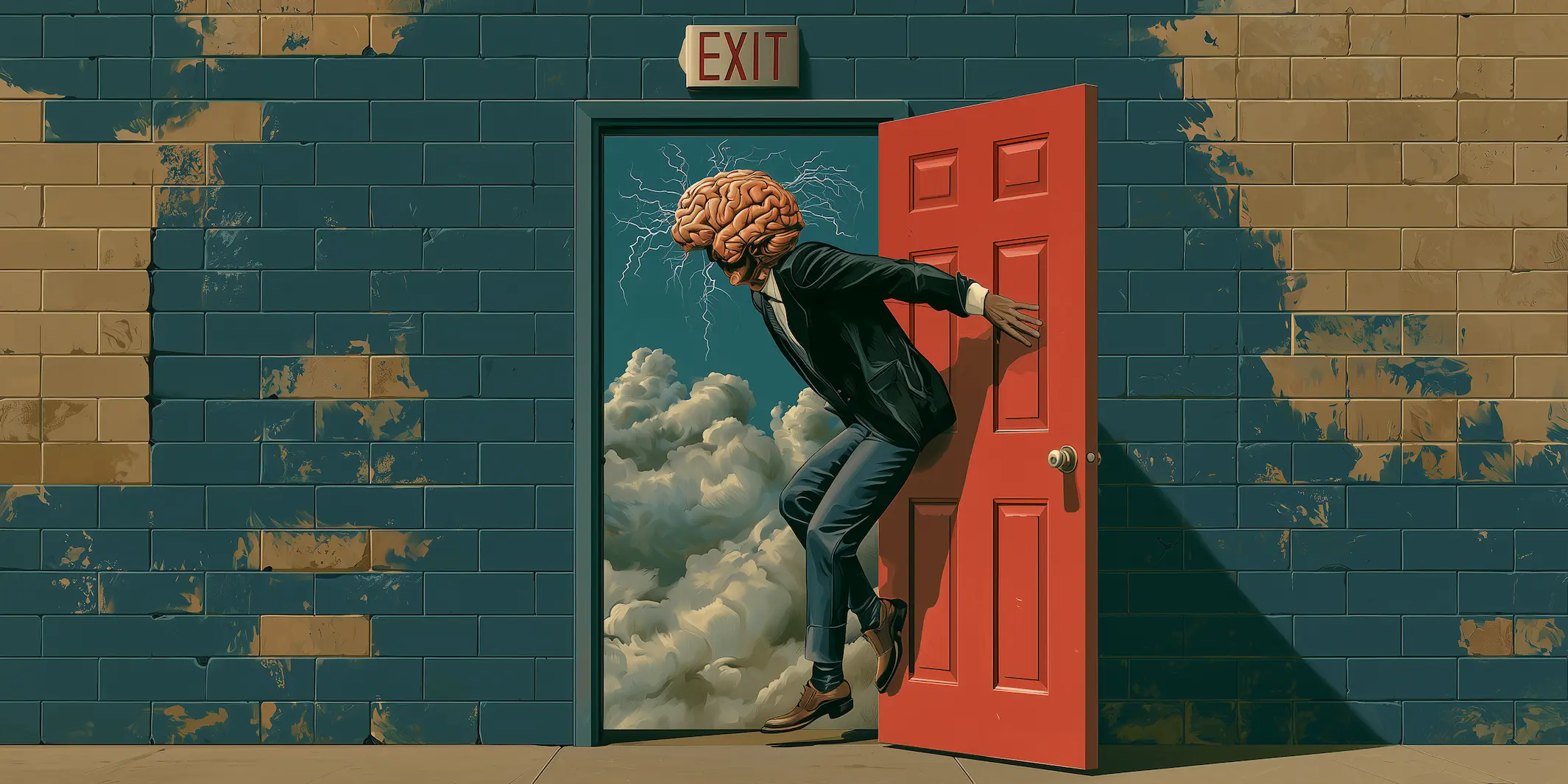
The Mind That Refuses to Leave
How Close Are We to Transferring Human Memory and Personality? There is an innate lure in our subconscious that finds it fascinating to copy a human mind.
A brain contains memories and the building blocks of a personality. Therefore, if we learn where the memories and personality are stored, we copy them, place the copy into another brain. If not yet, perhaps into a sufficiently accommodating compute. Thus so congratulate ourselves on having solved a spiritual mortality.
The difficulty is that practically every word in that argument conceals a problem.
We know that memories are stored in the brain. We do not possess a little drawer marked CHILDHOOD, another marked MARRIAGE, and a third containing the embarrassing incident at the Christmas party of 2007.
Memory is vastly distributed.
A recollection involves patterns spread across populations of neurons. This is based on their connections, changing strengths, chemical states and interactions with other cells. Worse, remembering is not simply reading information from biological storage. The brain reconstructs memories, and that reconstruction can change them. Modern neuroscience increasingly describes autobiographical memory as an active process that helps maintain our continuing sense of identity rather than as a perfectly preserved recording of the past.
This presents a difficulty to anyone proposing to upload Uncle George.
Which George shall we upload?
George at breakfast? George remembering his childhood? George angry? George frightened? George's brain before learning his granddaughter is getting married or five minutes afterward?
A human personality is not a file. It is a process.
Nevertheless, we are getting closer to pieces of the problem.
The field called connectomics attempts to map the enormous networks of neurons and synapses that make brains possible. Researchers can now construct extraordinarily detailed wiring diagrams of comparatively small nervous systems. Scientists have reconstructed the adult fruit-fly brain, containing more than 125,000 neurons and tens of millions of synaptic connections, and researchers are beginning to experiment with computational simulations based upon such maps.
A human brain, unfortunately, contains roughly in the neighborhood of 86 billion neurons.
Nature has a peculiar fondness for making interesting problems several orders of magnitude more difficult than necessary.
Even the mouse brain remains a formidable undertaking. Estimates for mapping its roughly 70 million neurons at extremely high resolution have involved hundreds of millions of dollars in imaging, vastly greater costs for reconstruction and verification, years of microscope operation and hundreds of petabytes of information.
The human brain is not merely a larger mouse brain and a wiring diagram may not be enough.
We may need to know the strengths of synapses, the condition of individual cells, molecular concentrations, electrical states and perhaps biochemical details whose importance we have not yet discovered. Researchers continue debating precisely how much biological information must be duplicated before a simulation ceases to be an imitation and begins behaving like the original brain.
So, can we transfer a person's memories into a clone?
No, not remotely at all at the moment.
A clone presents an additional misunderstanding. If I produced your genetic clone tomorrow, I would not obtain another you. I would obtain your delayed identical twin.
The clone would possess essentially the same genetic instructions but not your experiences. He would not remember your first bicycle, your mother, the person you first loved or the reason you dislike asparagus. His brain would develop according to its own experiences.
DNA builds the machinery but actual life writes much of the program.
To turn the clone into something resembling you, science would have to discover how to read the enormously complicated physical representation of your memories and personality and then somehow rewrite another living brain accordingly.
We currently cannot do either.
The computer route is more interesting because it permits cheating.
Instead of transferring your biological memory, suppose we reconstruct your behavior.
Give a sufficiently advanced artificial intelligence every letter you have written, every email, photograph, video and recording. Let it study decades of conversations. Tell it what books you enjoyed, whom you loved, what jokes amused you and what made you furious.
The resulting machine might eventually answer questions remarkably like you.
Modern language models are already being studied as personal-memory systems capable not merely of storing records but of interpreting and reconstructing a person's autobiographical material through conversation.
Imagine extending that program for thirty years.
Your computer listens, with permission, to your conversations. It knows your writings. It hears your stories repeatedly and observes how you change them. It learns your vocabulary, timing, humor, prejudices, uncertainties and contradictions.
Eventually your grandchildren might speak to it and say:
“What did Grandpa think about this?”
And Grandpa answers. Not with a quotation retrieved from a database.
With a new answer. That would be extraordinary!
It would also almost certainly not be Grandpa.
We must distinguish preserving information about a person from preserving the person.
That distinction may become one of the great philosophical arguments of the twenty-first century.
Suppose technology eventually maps every meaningful connection in your brain and constructs a computer simulation so precise that it awakens saying:
“My name is Gary. I remember being scanned. Why can't I feel my hands?”
Have you survived? Or has another being appeared who sincerely believes it is you?
There is no experiment presently capable of answering that question.
Research on whole-brain emulation treats the technical challenge seriously, but no human brain has been uploaded, and we cannot currently scan a living human brain at the synaptic detail that such a reconstruction might require.
Interestingly, researchers are also learning how remarkably long human neural tissue models can persist. In August 2026, scientists reported keeping human brain organoids growing for approximately five years, revealing developmental processes that continue over surprisingly long periods. These organoids are research models, not miniature people and certainly not containers for transferred personalities, but they demonstrate how much remains to be learned about the biology from which minds emerge.
So are we closer? Yes! Much closer than we were fifty years ago.
But not because we have nearly discovered the “download button” for the brain.
We are closer because we are finally beginning to understand how enormously complicated the button theoretically would have to be.
The first practical form of human preservation may therefore arrive by a different route.
We may build increasingly sophisticated digital versions of ourselves while we are alive. These systems would remember our histories, learn our mannerisms, preserve our voices and continue conversing after the biological original has disappeared.
They will begin as archives. Then assistants and subsequently companions.
Eventually one may know a person so thoroughly that distinguishing between conversation with the original and conversation with the reconstruction becomes uncomfortable.
At that moment humanity will confront a question considerably more difficult than whether we can copy a mind.
We will have to decide what we mean by one.
And perhaps that is the real problem we have been approaching all along.